Download
1 variant available


53
109
2.6K


Introduction
💪 UniFlex isn't just a workflow...it's a unified flexible and extensible modular framework, where things look and work roughly the same regardless of the model used or imaging task required. The most commonly used tools for local AI image generation are at your fingertips, while a suite of power tools are at the ready when needed.
The workflow is heavily annotated 🗒️ and includes a number of pre-configured samples 📦 for you to learn and build, without needing to buy access or dig through intentional obfuscations (e.g., node stacking). Native ComfyUI nodes have been used as much as possible, with the Core 🦴 edition requiring only ONE custom node package!
🔮 Krea 2 remains the flagship model for the latest major version. However, other models supported with annotations, instructions, and/or pre-configured sample workflows include Anima (incl. Anima-LLLite); Bernini-R; Boogu-Image [Edit]; Chroma1-HD; FireRed-Image-Edit; Flux.1 Dev; Flux.2 Klein 9B; Ideogram 4; JoyAI-Image-Edit [Plus]; Mage-Flow [Edit]; Qwen-Image [Edit]; SDXL (incl. Illustrious, Pony, etc.); and Z-image.
Development and testing occurred on the following system:
Operating system: Linux Mint 22.3 Cinnamon with 124 GB RAM
Processor: 11th Gen Intel© Core™ i9-11900 @ 2.50GHz × 8
Graphics card: NVIDIA GeForce RTX 3060 with 12 GB VRAM
Browser: Google Chrome
Please report bugs 🪲 or errors 🚫, as well as successes 🤞 and requests/suggestions 📝. Post and share your SFW creations!!! I spent a lot of time working on this project (((for no 💰))), so I hope others make good use of it and find it helpful.

Power Tools *
Background Removal & Segmentation:
ControlNets, Detailing, & Inpainting:
🔮 Krea 2 reference images controls —so fun!...kind of like Flux Redux
LanPaint with Crop-and-Stitch
LLMs for Text & Vision:
Prompting:
LLM-driven prompt enhancers
Wildcards (OutputLists Combiner)
Upscaling:
Model-based, PiD †, RTX Super Resolution, SeedVR2 †, SesquiLSR, and SUPIR †
XY Plots:
XY plots (OutputLists Combiner)
* = stripped down Core 🦴 edition is also included in the download package; † = native ComfyUI implementation
What's New?
[13.x] This major version represents a culmination of the incremental improvements made through the 12.x series, with some additional changes to custom node packages and QOL improvements. At this point, I think the workflow is about as clean as I can get it, given the functions being implemented and current stage of ComfyUI development. 🔮 Krea 2 remains the flagship model, with additional components and settings particular to its use.
[12.x] This major version basically represents a culmination of the incremental improvements made through the 11.x series, with some additional changes to custom node packages, QOL improvements, and a new color scheme. 🔮 Krea 2 remains the flagship model, with additional components and settings particular to its use. [12.3] Added support and pre-configured samples for Anima-LLLite, Mage-Flow —Turbo, and Mage-Flow-Edit —Turbo. [12.3] Added SesquiLSR latent upscaling; getting much better results than ComfyUI's native methods. [12.3] Added SPEED sampler for potentially faster rendering. [12.3] Cleaned up the Prompt Builder subgraph; gives better demonstration of some possibilities for constructing wildcard prompts. [12.3] Collapsed many of the GetNodes into subgraphs for a cleaner look. [12.3] Trimmed down annotations and instructions in the core workflow that mostly applied to the main workflow or covered more complex configurations. [12.3] Restructured the Prompt group by moving several components into the Prompt subgraph. [12.3] Found some speed optimizations by removing preview image and text nodes inside subgraphs that were running for no reason (in most cases). [12.3] Added a "boosted settings" pre-configured workflow, with additional LoRAs, faster sampler, K2 native schedulers, and latent upscaling automatically enabled. [12.3] Additional tweaks and QOL improvements. [12.2] Added Krea2Edit back in after several alternatives were reviewed. [12.2] Made some tweaks to the default settings that should give better (cleaner, sharper) results...maybe? [12.2] Additional tweaks and QOL improvements. [12.1] Replaced as many nodes from the Easy-Use and rgthree packages as possible, with the former no longer required at all and the latter only used for the Switchboard (which can be removed if a user wants to just mute groups by scrolling around). The core workflow was also trimmed of custom nodes and now requires just ONE (KJNodes)!
Known Issues
[13.x] 🛑 LAYOUT NOT COMPATIBLE WITH NODES 2.0 🛑
[13.x] The included pre-configured sample workflows are provided for proof of concept, but the most up-to-date workflows will always be the 🔮 Krea 2 and 🔮 Krea 2 —Core workflows.
[13.x] Several argument flags are known to have incompatibilities with many models and configurations, so start ComfyUI without them when testing things out. These are known to have been problematic for me: --fast, --force-channels-last, --fp8_e4m3fn-unet, and --use-sage-attention.
Quick Start
Install or update ComfyUI to the very latest version. Follow the official Comfy documentation or your favorite YouTube installation video, if needed.
Check that ComfyUI Manager is available, or install it.
Download the 🔮 Krea 2 model, along with its text encoder and VAE, from the Comfy-Org Hugging Face repository.
Open the pared down Core 🦴 edition of the 🔮 Krea 2 workflow in ComfyUI. (Later you can try the main workflow.)
Use the Manager to Install Missing Custom Nodes.
Restart ComfyUI.
Open the workflow again and follow the General Workflow Defaults instructions. For now, it will basically be to load your diffusion model, text encoder (CLIP), and VAE (01a), and then temporarily bypass the LoRAs subgraph (03c; only the subgraph, not entire sub-group).
Run the default text-to-image recipe 🥣.
If everything passes, inside the LoRAs subgraph (03c) re-enable the turbo LoRA, if needed.
Enjoy your generated image creations! 😎
Navigation
The workflow is structured for flexibility. Many unconnected nodes have intentionally been included to provide options and ideas for endless tweaking. (The workflow does not employ Anything Everywhere, so if a node connection looks empty, it really is empty.)
In the Switchboard group (in the main workflow), flip the yes|no 🔵 toggles to mute or unmute groups and the jump arrows ➡️ to quickly move to particular groups for adjustments. 🛑 Do NOT run the workflow with all switches flipped to yes!

Once you have the main diffusion model, text encoder (CLIP), VAE, and LoRAs in their correct working locations for your setup, you should be able to just ignore any additional missing model errors if they appear. If the scary red boxes bother you, in the Comfy > Workflow section of the settings, turn off Show missing models warning. (Alternatively, almost all of the problematic groups/subgraphs can just be deleted and the default workflow recipes should still work.)

In the rgthree settings (if installed), it is also recommended to show fast toggles in group headers for muting.

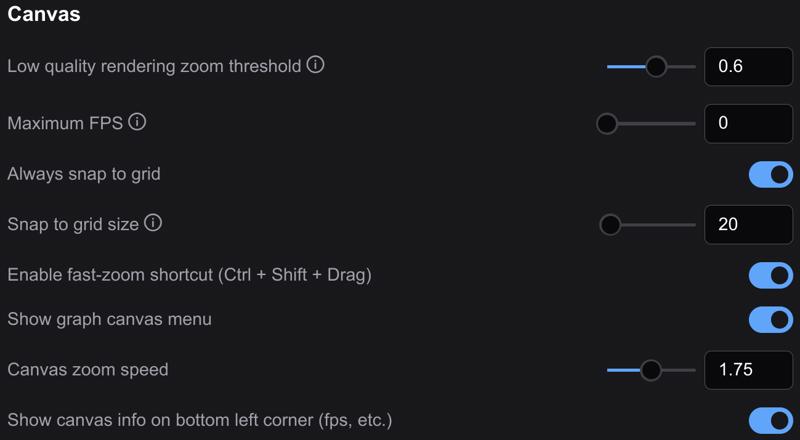
In the Lite Graph section of the settings, enable the fast-zoom shortcut and set the zoom speed to around 1.5–1.75. The workflow was built with a snap to grid size of 20.
 Most of the workflow is unpinned 📌, so grab any empty space with your mouse to navigate around. You are welcome to pin 📌 anything you like to prevent accidentally moving groups or nodes.
Recipes
Run the default text-to-image recipe 🥣 to confirm you have the basics configured correctly before too much tweaking. Once you have the workflow running, drag-and-drop your rendered image back onto the ComfyUI canvas to continue working. This ensures you will always have a good default workflow as fallback. 🏅
The workflow is heavily annotated 🗒️ and includes a number of pre-configured samples 📦 for you to learn and build!